

Every blockchain relies on its consensus mechanism to uphold secure and decentralized operation. Validators play a vital role by verifying transactions, producing blocks, and maintaining consensus.
Core introduces a unique consensus model called Satoshi Plus, a hybrid of:
Delegated Proof of Work (DPoW)
Delegated Proof of Stake (DPoS)
Self-Custodial Bitcoin Staking
This approach combines the security of Bitcoin’s hash power with the scalability of Proof-of-Stake systems.
This article explores the role of validators on Core, the details behind the election process, and breaks down the reward allocation process for both validators and their delegators.
Validator Responsibilities
Validators uphold the Core network’s integrity by:
Verifying transactions and proposing blocks.
Participating in the consensus process.
Ensuring decentralization, transparency, and network security.
Key Characteristics:
Security: Prevent double-spending and maintain state consistency.
Transparency: All actions (e.g., commission changes, slashing events) are logged on-chain.
Decentralization: Validators operate independently and globally, ensuring fair participation.
Becoming a Validator on Core
Becoming a validator on Core requires more than just technical setup—it demands on-chain registration, alignment with the community, and the ability to attract delegations from multiple sources, including BTC, CORE tokens, and Bitcoin hash power.
Set Up a Core Full Node: Ensure your system meets all technical requirements and run a fully synchronized Core node.
Register On-Chain: Complete the validator registration by submitting your consensus address, fee address, commission rate, and a refundable deposit of at least 10,000 CORE tokens.
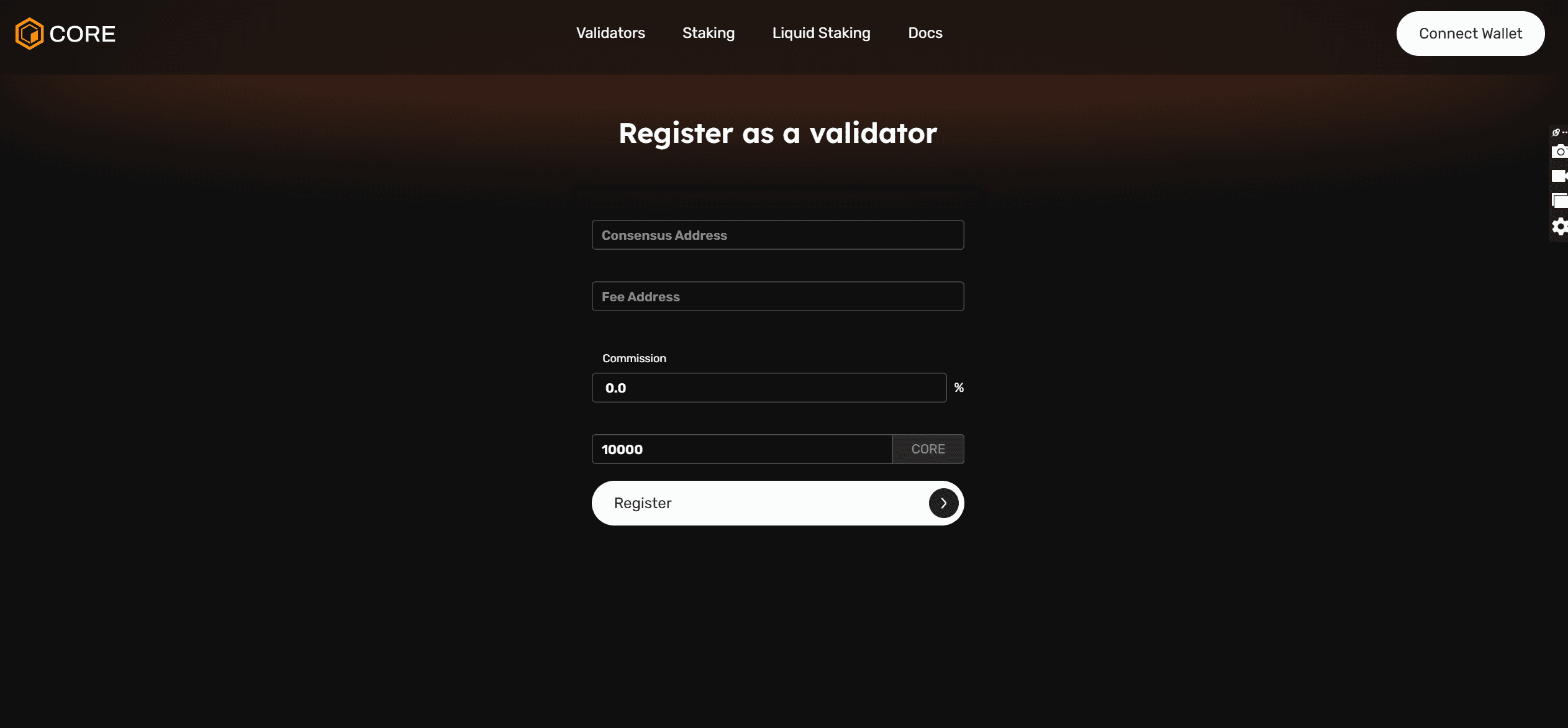
register as validator on Core
Attract Delegations: To boost your hybrid score and secure validator status, actively seek delegations from CORE holders, Bitcoin miners, and BTC stakers.
The Validator Election Process
Validator selection on Core follows a structured, multi-phase process rooted in the Satoshi Plus consensus, which integrates Delegated Proof of Work (DPoW), Delegated Proof of Stake (DPoS), and Self-Custodial Bitcoin Staking into a unified hybrid scoring system.
On the Core network, elections occur at scheduled intervals, known as epochs. At the end of each epoch cycle, a new set of top-ranking validators is elected to oversee block production and network governance.
Sources of Stake Delegation:
Validator ranking is determined by delegations from three distinct sources:
Delegated Proof of Work (DPoW): Bitcoin miners delegate hash power to Core validators by including validator vote metadata in the op_return field of Bitcoin coinbase transactions when they mine blocks. This allows miners to earn supplemental CORE rewards without changing their Bitcoin mining operations or diverting hash power from Bitcoin.
Delegated Proof of Stake (DPoS): CORE token holders delegate their tokens to validators through Core's staking mechanism. Delegated CORE tokens contribute to a validator's hybrid score and enable token holders to earn rewards based on validator performance.
Self-Custodial Bitcoin Staking: Bitcoin holders timelock their Bitcoin on the Bitcoin blockchain using Bitcoin's native CLTV function and include metadata specifying which Core validator to support. The timelocked Bitcoin contributes to the validator's hybrid score while the Bitcoin remains in the holder's custody throughout the staking period.
Hybrid Score Calculation
The validator election process revolves around the hybrid score calculation, which assigns weights to each type of delegation. The formula for calculating the hybrid score is:
S = (rHp / tHp) * m + (rSp / tSp) * k + (rBp / tBp) * l
Where**:**
rHp: Hashpower delegated to the validator
rSp: CORE staked to the validator
rBp: BTC staked
tHp, tSp, tBp: Total values across the network
m + k + l = 1: Weights assigned to each delegation type
This hybrid scoring system ensures a balanced contribution from both the BTC and CORE.
Validator Set Formation:
At the end of each round (spanning 1 day), a new active validator set of 31 validators is selected based on their hybrid scores. These scores are calculated using factors such as hash power delegation and staked BTC and CORE tokens.
Instead of monitoring validator status in real-time, the network checks validator status once per epoch (10 minutes or 200 slots). This approach ensures stable transactions per second (TPS) across rounds while periodically excluding jailed or underperforming validators from the next round.
Being part of the active validator set is both an opportunity and a responsibility. Validators earn rewards for contributing to Core's Satoshi Plus consensus but are subject to strict penalties for malicious behavior or poor performance.
Slashing Risks: Validators may lose a portion of their staked CORE tokens for network violations, such as double-signing, prolonged downtime, or other protocol breaches.
Jailing: Underperforming validators are jailed, disqualifying them from producing blocks or earning rewards and damaging their reputation.
Risk of Losing Delegation: Validators with high commission rates, frequent downtime, or a history of slashing risk losing delegations as stakeholders reallocate to more reliable validators.
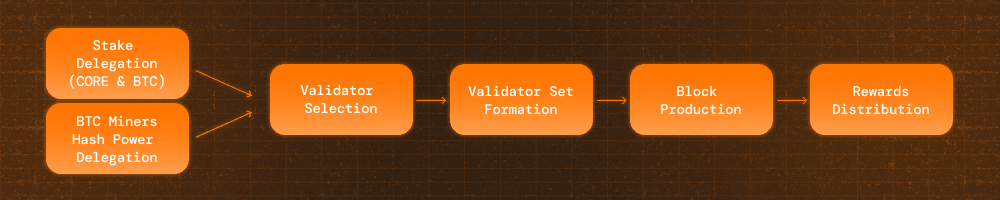
Validator set foundation
Block Production:
The 31 elected validators, forming the active validator set, take turns forming new blocks in a round-robin manner. Each validator is allocated a slot lasting up to 3 seconds, during which they propose one block.
During their assigned slot, the validator aggregates, validates, and appends transactions to the blockchain. If a validator fails to produce a block within their slot, the next validator in line takes over. This process repeats in cycles, ensuring continuous block production.
Reward Distribution
Validators earn rewards from two primary sources:
- Block Rewards: Newly minted CORE tokens are distributed at the end of each round.
- Transaction Fees: Fees collected from transactions included in each block.
Both reward types are calculated and distributed when the final block of the last round is mined. The distribution is as follows:
90%: Allocated to the validators.
10%: Redirected to the System Reward Contract.
Since all validators have equal opportunities to propose blocks, rewards are generally distributed evenly among them.
From the 90% allocated to validators, they retain only a portion as a commission fee. The remainder is distributed to their delegates. Validators set their commission rates, balancing their share and the payout to delegators. Offering competitive terms often helps validators attract more stake from delegators.
Conclusion
Core's validator system operates through Satoshi Plus consensus, which integrates delegations from Bitcoin miners, Bitcoin holders, and CORE token holders into a unified hybrid scoring mechanism. This approach creates a multi-layered security model where validators are elected based on support from three distinct stakeholder groups, each contributing to network security through different mechanisms. The resulting validator set benefits from Bitcoin's economic weight and hash power while maintaining the performance needed for a thriving smart contract platform. Understanding how validators are elected and rewarded is essential for anyone looking to participate in Core's consensus mechanism, whether as a validator, delegator, or developer building applications on the network.