
A goal behind the CORE token is to make it the second asset that Bitcoiners care about—not by competing with Bitcoin, but by complementing it. This shift is happening for two key reasons: CORE provides genuine value to Bitcoin holders through its utility, and its tokenomics create sustainable, long-term value accrual rather than temporary yield farming.
How to Think About Emissions
Unlike yield farming projects that exist primarily to distribute rewards, CORE serves as the foundational utility token of a high-performance, EVM-compatible blockchain and thriving Bitcoin scaling ecosystem. The token's sustainable value stems from both its role in powering this ecosystem and its utility in unlocking enhanced Bitcoin yields.
The Ecosystem Undergirding Yield
Many Bitcoin holders retain CORE because they see long-term growth potential in the broader ecosystem. Core isn't merely a yield platform but a comprehensive Bitcoin-focused DeFi ecosystem with:
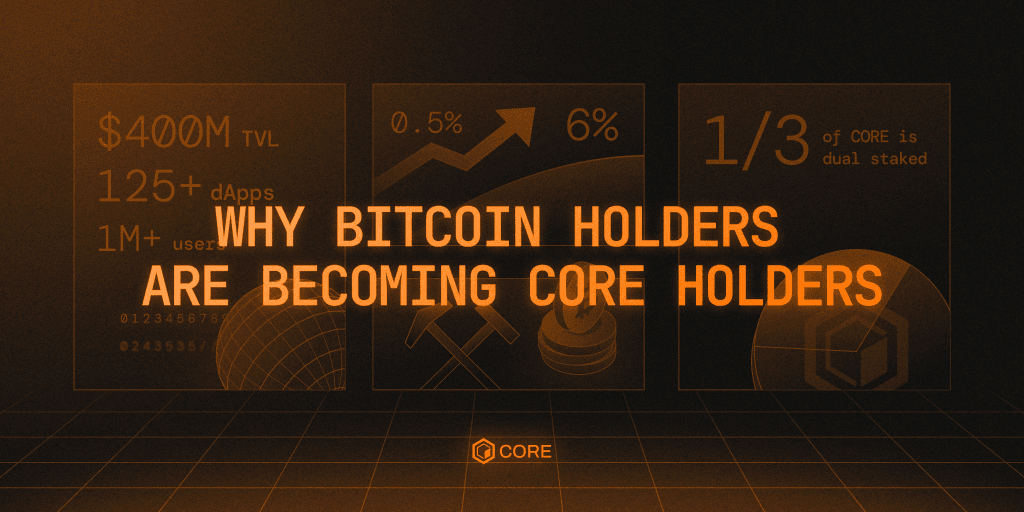
125+ dapps spanning lending, borrowing, trading, and gaming
$400+ million TVL
400+ million total transactions
Hundreds of thousands of daily transactions
1M+ weekly active users
This active ecosystem creates genuine demand for CORE tokens beyond staking incentives. Users need CORE for transaction fees, governance participation, and accessing various DeFi services across the network.
Real Utility Incentivizes Holding
For Bitcoin holders more focused on yield generation, CORE tokens provide immediate practical value. A core utility is unlocking higher Bitcoin staking yields through Dual Staking:
Self-Custodial Bitcoin Staking alone yields 0.1-0.5% APY
With sufficient CORE tokens, the same Bitcoin can earn ~4-6% APY
Access to the highest "Satoshi Tier" yields requires maintaining a specific CORE-to-BTC ratio
This creates a compelling economic proposition: by acquiring CORE today, holders accelerate years of potential yield they would otherwise accumulate gradually. Rather than waiting to build a position solely through rewards, Bitcoin holders can optimize returns by directly acquiring CORE or borrowing against their timelocked Bitcoin principal at conservative LTVs.
This system incentivizes upfront demand for CORE rather than passive accumulation, effectively pulling forward years of would-be emissions. The economics are designed so that acquiring CORE tokens today represents substantially more demand than the supply of emissions that would be accrued over over one year of Dual Staking, creating significant incentive alignment between Bitcoin stakers, CORE stakers, and the Core network.
CORE's Optimized Tokenomics: Supply and Demand Mechanics
The Multiplier Effect
The mathematics of CORE acquisition reveals a powerful dynamic: Acquiring CORE tokens is designed to create demand that is multiples greater than the emissions received over one year.
Here’s an illustrative example of how Core’s system works, using historical data approximations for educational purposes only (not live data).
Staking 100 CORE at the highest yield tiers can earn 25 CORE in annual rewards
This means direct purchases would immediately secure a position that would take ~4 years of staking rewards to offset
This multiplier effect can create several cascading benefits:
- Immediate reduction in circulating supply as purchased tokens are often staked
- Increased yield value as the underlying token strengthens
- Enhanced scarcity as more tokens are locked in staking positions
Not Yield Farming
CORE's tokenomics stand in stark contrast to traditional yield farming front-loading:
Fixed maximum supply of 2.1 billion tokens
81-year emission schedule with a 3.61% annual reduction rate
Predictable, gradually decreasing issuance creating long-term sustainability
This approach resembles Bitcoin's own supply mechanics but with a smoother reduction curve than Bitcoin's sharp halvings. It's designed for sustainable, multi-decade growth rather than short-term yield spikes.
Unlike yield farming tokens that often have unpredictable or unlimited supply, CORE's economics create enduring value through predetermined scarcity—making it behave more like a productive asset than a temporary yield opportunity.
Becoming Bitcoin's Companion Asset
CORE is designed to be the natural second asset in every Bitcoin holder's portfolio. Evidence of this strategy's success is already emerging with groups including:
Bitcoin miners — traditionally among the most Bitcoin-maximalist participants — are now staking a portion of their rewards in CORE.
Institutional Bitcoin treasuries are exploring Core’s Dual Staking.
ETP/ETF issuers — already holding large Bitcoin positions — are using Core to earn trustless yield on otherwise idle Bitcoin.
Valour’s yield-bearing BTC ETP has generated 5.65% APY exclusively using Core’s staking offerings.
As of May 2025, ~⅓ of all CORE staked is dual staked alongside Bitcoin.
Value Beyond Emissions
CORE’s sustainable value to Bitcoin holders stems from many interconnected strengths, including:
- Utility-Driven Retention: CORE's role in unlocking higher Bitcoin yields creates rational reasons for holders to maintain or increase their positions rather than selling rewards.
- Multiplicative Acquisition Effect: The relationship between buying and yield means direct acquisition creates immediate, substantial impact on token supply-demand dynamics.
- Bitcoin-Aligned Economics: The fixed supply cap and 81-year fixed emission schedule promote predictable, long-term incentive-alignment.
These mechanics are already attracting some of Bitcoin's most conservative stakeholders—miners and institutional participants—hinting at progress on CORE’s journey to becoming Bitcoin's natural companion asset. As the Core ecosystem continues expanding both its utility and user base, the token's fundamental value proposition only strengthens, making it increasingly clear why Bitcoin holders are becoming CORE holders.